Face to Face...
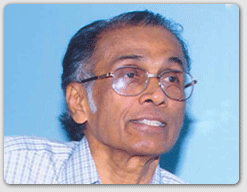
A Dialogue with
Prof. J Mahender Reddy,
Vice Chancellor,
Icfai University, Tripura
It is said that a man's face is the index to his personality/character. And,
one look at Prof. J Mahender Reddy will convince you that here is a man given
to simple living and high thinking. While his simple lifestyle is proof of the
first trait, his academic qualifications and achievements prove the latter.
After distinguishing himself in various posts, Prof. Reddy is now the Vice
Chancellor of Icfai University, Tripura. Having asssumed the reins in July
2004, he has initiated several programs in the university. The latest among
them is the PhD program, which is to be launched shortly. In the following
interview with T Nagamani, he elaborates on this pet program of his.
Can you tell us about the PhD program which Icfai University, Tripura is
launching ?
The Doctoral Program offered at INC Research Staff College is similar to the one
at IIMT. It culminates in the award of a PhD degree in Management from Icfai
University, Tripura, leading to placement of the candidates as assistant
professors in one of the 18 INC campuses. The selected candidates spend 15
months on the campus INC Research Staff College (IRSC). For quality research
what is crucial is logical reasoning, understanding the data and a critical
evaluation of research already done in that area. The students are exposed to
all this during the course work and MPhil thesis preparation during the first
15 months.
During this period they complete the course work, workshops on pedagogy, PhD
qualifying examination and MPhil thesis. After the initial period of 15 It is
said that a man's face is the index to his personality/character. And, one look
at Prof. J Mahender Reddy will convince you that here is a man given to simple
living and high thinking. While his simple lifestyle is proof of the first
trait, his academic qualifications and achievements prove the latter.
After distinguishing himself in various posts, Prof. Reddy is now the Vice
Chancellor of Icfai University, Tripura. Having asssumed the reins in July
2004, he has initiated several programs in the university. The latest among
them is the PhD program, which is to be launched shortly. In the following
interview with T Nagamani, he elaborates on this pet program of his. INCAS
Network Vol 1| Issue 3 | September 2008 � 5 Face to Face months at the
Hyderabad Campus they will be posted in INC centers of their choice.
They work on their PhD thesis proposal under the guidance of a faculty member in
the city where they are located. They complete the PhD thesis proposal at the
end of second year and finally the PhD thesis in another two years. The focus
of the doctoral thesis is more on practical applications and policy-oriented
research. The duration of the PhD program is four years. At the end of four
years, the successful candidates will have their MPhil and PhD degrees in hand,
some publications to their credit, and three years of teaching experience and
an assistant professor position. Thus, it is an extremely valuable proposition
for prospective students joining this program. The students are paid a
scholarship of Rs. 20,000 in the first year, Rs. 22,500 in the second year and
Rs. 25,000 in the third and fourth years.
This is more of a public-private partnership as the candidate is from a private
university and the Supervisor may be from a state/central university or a
research institution. Alternatively, it can be a private-private partnership
where the supervisor may also be from a private institution.
INCAS considers creating a platform for mutual learning through seminars,
periodicals and newsletters. It also strengthens the INC brotherhood by
organizing loyalty programs at center, regional and national levels to attract
alumni as a part of KIT (Keep In Touch) campaign.
How is it distinctive from the PhD programs of the other universities?
The PhD program offered by Icfai University, Tripura distinguishes itself from
other state and central universities in two ways:
It has a rigorous course work and PhD qualifying examination which better
prepares the students to carry on their PhD thesis work as is the practice in
American universities.
The students are exposed to a series of workshops such as case study, soft
skills, teaching aids, curriculum design, consultancy, institutional
development, etc., which, enables them to become good teachers.
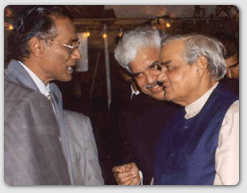
Prof. J Mahender Reddy with former Prime Minister A B Vajpayee
Erudite and experienced
Prof. Mahender Reddy graduated from Osmania University in 1962.
He then did the Masters Program at the Delhi School of Economics. He completed
his PhD in 1970 at the University of Alberta, Edmonton, Canada. He then taught
in the Management School in that university for two years and later moved to
the United States on a regular, permanent position. But the urge to return to
India brought him back here.
UGC special assistance program.He joined the Department of Economics of Osmania
University as Associate Professor in 1977 and later became Professor, Chairman
Board of Studies and Head of the Department and also Coordinator of the UGC
special assistance program.
While serving the university,
he had won the Shastri Indo-Canadian Institute Fellow twice-in 1985-86, at
Carleton University and in 1990- 91, at Ottawa University. He was selected by
the Fulbright Foreign Scholarship Board for a Fulbright Grant sponsored by the
United States Information Agency and administered by the Council for
International Exchange of Scholars in Washington, DC.
He was honored with the Best Teacher Award by the Government of Andhra Pradesh
in the year 2002.
You are the Founder-Principal of Icfai Institute for Management Teachers in
Hyderabad. How was it set up and what are its activities?
I shifted to Icfai in June 2002 and was appointed as the Founder-Principal of
Icfai Institute for Management Teachers. My nine years of association with the
universities in the United States/Canada helped me to adjust easily to the
Icfai culture. The Institute's main objective was to conduct the Management
Teacher Program leading to PhD. The program has four phases, namely, course
work, PhD qualifying examination, preparation of thesis proposal and visiting
scholar program, and completion of thesis work. The objective of the course
work is to impart scholarship and to equip the candidate with the latest
developments in the discipline. The qualifying examination tests the
candidate's knowledge in the prescribed areas and his/her ability to apply the
same in research. On completion of the qualifying examin- -ation, the candidate
registers for the independent study courses and prepares the research proposal
under the guidance of a Doctoral Advisory Committee. Once the research proposal
is complete, the candidate starts working on the PhD thesis. As a part of the
program, the student spends a year abroad in an institution with which Icfai
has signed an MoU. This gives an exposure to teaching and research in an
international context.
The success of IIMT experiment is due to the guidance provided by the top
management and faculty who have spent considerable time in molding the students
in the science and art of research. While a good library, computer software,
databases and a good infrastructure are necessary, there is no substitute for a
competent faculty. The challenges involved in the completion of doctoral thesis
even after successful PhD qualifying examination are many. One requires hard
work, patience, determination and some luck.
The responsibility of a head of an institution/school/department should be more
and more on creating a congenial environment where students, administrative
staff and faculty should be free to express their views and work to their
utmost in the organization. He/she should be willing to sacrifice his/her
research work in the interest of the development of the research work of
others. He/she should play a catalyst role in the development of research by
the students and faculty. In an academic organization like this, procedures
have a minimal role. It is all resultdriven.
What has been your most satisfying experience in the Icfai University?
The most satisfying experience was to witness the process of transformation of a
student becoming a good teacher and a competent researcher. It should be noted
that teaching and research are two sides of the same coin. I was happy to see
the students achieving both the goals. During the last six years, I have been
deeply involved with a body-mind-soul-commitment to the job. This has been
possible because of the guidance provided by the top management at Icfai
University, a committed faculty and, above all, family support.